
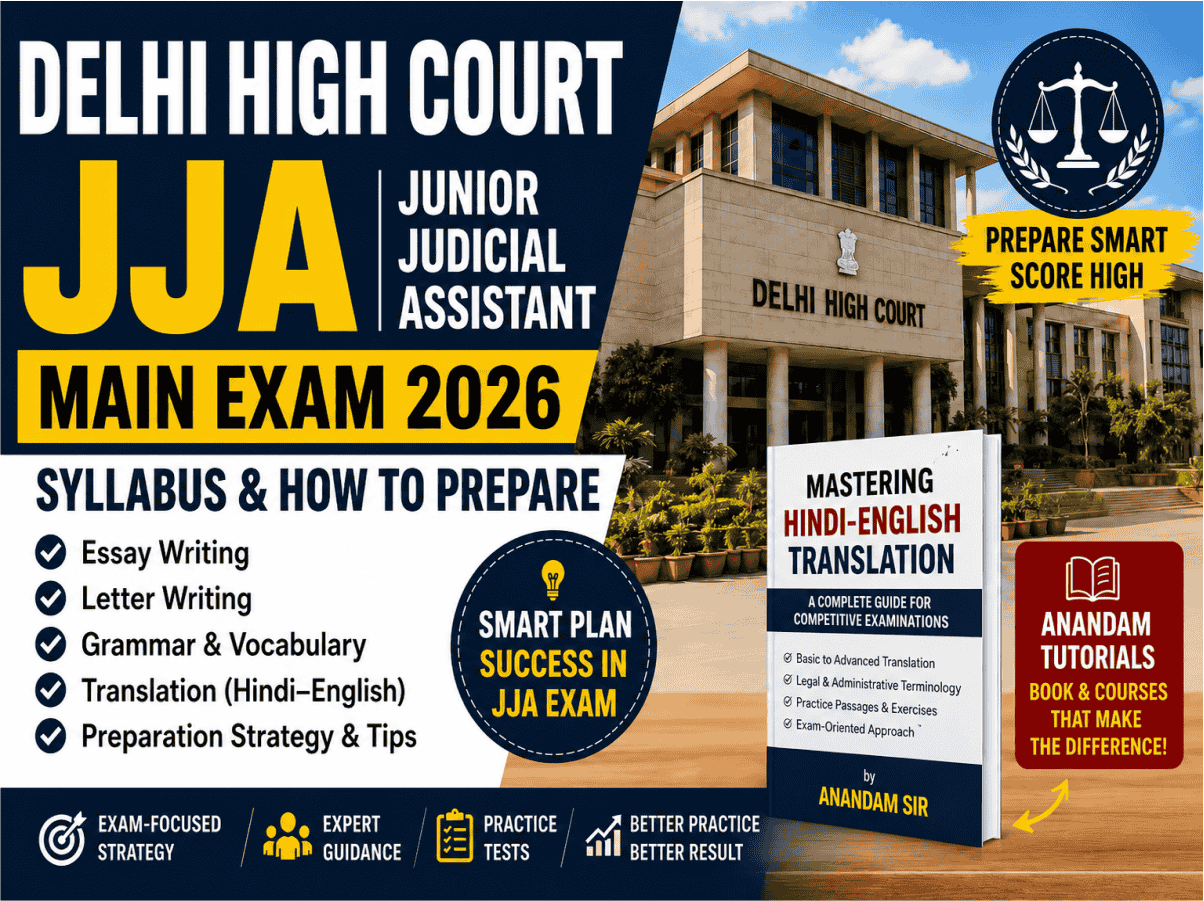
The Delhi High Court Junior Judicial Assistant (JJA)/Restorer Examination is one of the most sought-after recruitment examinations for graduates aspiring to secure a prestigious position in the judicial establishment. The examination not only tests a candidate's command over the English language but also evaluates drafting, translation, grammar, comprehension, and communication skills.
Success
in this examination requires a systematic preparation strategy, especially for
the Main (Descriptive) Examination, which is often the deciding factor in the
final selection.
Understanding the JJA Main
Examination Syllabus
Total Marks – 100
Time – 120 Min.
Part – A
Writing Skills
Full Marks - 50
(i) Essay Writing – 40 Marks (250
words)
(ii) Letter Writing – 10 Marks
Part – B
Language Application
Full Marks – 50
English Grammar – 30 Marks
Translation – 20 Marks
Syllabus in detail
Based on
previous examination patterns, the Main Examination generally assesses
candidates in the following areas:
1. Essay Writing
Candidates
are required to write an essay on a contemporary, social, legal,
constitutional, environmental, or administrative topic.
2. Letter Writing
Formal
and official letters are generally asked, requiring candidates to demonstrate
clarity, precision, and proper format.
3. Grammar and Language Skills
This
section may include:
- Error
Detection
- Voice
Change
- Interrogative
Transformation
- Exclamatory
Transformation
- Polite
Requests
- Comparative
Degree
- Negative
Sentences
4. Vocabulary
Questions
may be asked on:
- Meanings
of Words
- Synonyms
- Antonyms
- One-word
Substitutions
- Distinguishing
Similar Words
5. Sentence Arrangement and Fill in the Blanks
Candidates
may be required to:
- Rearrange
words into meaningful sentences
- Complete
passages using appropriate vocabulary
6. Translation
This is
one of the most important sections.
Candidates
are usually required to:
- Translate
English passages into Hindi
- Translate
Hindi passages into English
Translation
passages often involve:
- Administrative
subjects
- Legal
themes
- Governance
and constitutional matters
- Social
and contemporary issues
Detailed Preparation
Strategy
Essay Writing
Candidates
should prepare at least 25–30 important topics, such as:
- Judicial
Reforms in India
- Artificial
Intelligence and Employment
- Youth
as Agents of Social Transformation
- Climate
Change and Sustainable Development
- Digital
India
- Women's
Empowerment
- Cyber
Crime
- Constitutional
Values
Recommended Practice
- Write
one essay every week.
- Focus
on introduction, body, and conclusion.
- Use
factual content and constitutional references wherever possible.
- Take
guidance from Anandam Sir
Letter Writing
Practice:
- Official
letters
- Semi-official
letters
- Complaint
letters
- Suggestion
letters
Particular
attention should be paid to:
- Format
- Salutation
- Subject
line
- Formal
tone
Grammar
The
grammar section is often scoring.
Prepare:
- Tenses
- Voice
- Narration
- Subject-Verb
Agreement
- Articles
- Prepositions
- Modals
- Error
Detection
Daily
practice of grammar exercises is essential.
Vocabulary
Candidates
should maintain a notebook containing:
- New
words
- Synonyms
- Antonyms
- Idioms
- Phrases
- Legal
terminology
Learning
10–15 words daily can significantly improve performance.
Translation Preparation
Translation
is often the most challenging section for many candidates.
Hindi to English Translation
Focus on:
- Tense
- Voice
- Modals
- Participles
- Infinitives
- Administrative
terminology
English to Hindi Translation
Focus on:
- Official
Language style
- Administrative
vocabulary
- Legal
terminology
- Natural
Hindi expression
Regular
translation practice is indispensable.
How Anandam Tutorials Helps
Aspirants
Mastering Hindi-English Translation
The book "Mastering
Hindi-English Translation" by Ashish Kumar (Anandam Sir) has been designed
specifically for competitive examinations involving translation.
The book
covers:
Basic to Advanced Translation
- Tense
- Voice
- Narration
- Infinitives
- Participles
- Modals
- Conditional
Sentences
Administrative Translation
The book
contains extensive practice on:
- Government
terminology
- Administrative
passages
- Official
correspondence
Legal Translation
Particular
emphasis has been given to:
- Court
terminology
- Judicial
vocabulary
- Legal
phraseology
- Constitutional
expressions
Practice Material
The book
provides:
- Translation
exercises
- Model
passages
- Objective
questions
- Error
analysis
- Examination-oriented
practice
This
makes it highly useful not only for Delhi High Court JJA but also for:
- SSC
CHT (JHT/SHT)
- RRB
JHT
- Supreme
Court Translator
- High
Court Translator
- Rajbhasha
Adhikari Examinations
Anandam Tutorials Online
Course
Apart
from the book, Anandam Tutorials offers dedicated courses for High Court Translator
Exams and its Assistant Exam that focuse on:
Live Classes
Students
receive systematic guidance on:
- Translation
techniques
- Grammar
- Vocabulary
- Legal
and administrative language
Extensive Practice
The
course includes:
- Translation
drills
- Mock
tests
- Evaluation
- Feedback
Examination-Oriented Approach
Special
emphasis is laid on:
- Accuracy
- Speed
- Official
language style
- Error-free
translation
Personal Guidance
Students
receive practical strategies for:
- Descriptive
examinations
- Translation
papers
- Interview
preparation
Final Advice
The Delhi
High Court JJA Main Examination is not merely a test of language; it is a test
of precision, clarity, and communication skills. Candidates who combine strong
grammar, rich vocabulary, effective writing skills, and regular translation
practice stand a much better chance of success.
A
disciplined study plan, continuous writing practice, and systematic translation
training can significantly improve performance in the examination.
For
candidates seeking comprehensive preparation, Anandam Tutorials'
"Mastering Hindi-English Translation" book and its specialized
translation course provide a structured pathway from fundamentals to advanced
examination-level proficiency.
Start
early, practice consistently, and focus on quality rather than quantity.
Success in the Delhi High Court JJA Examination will follow.